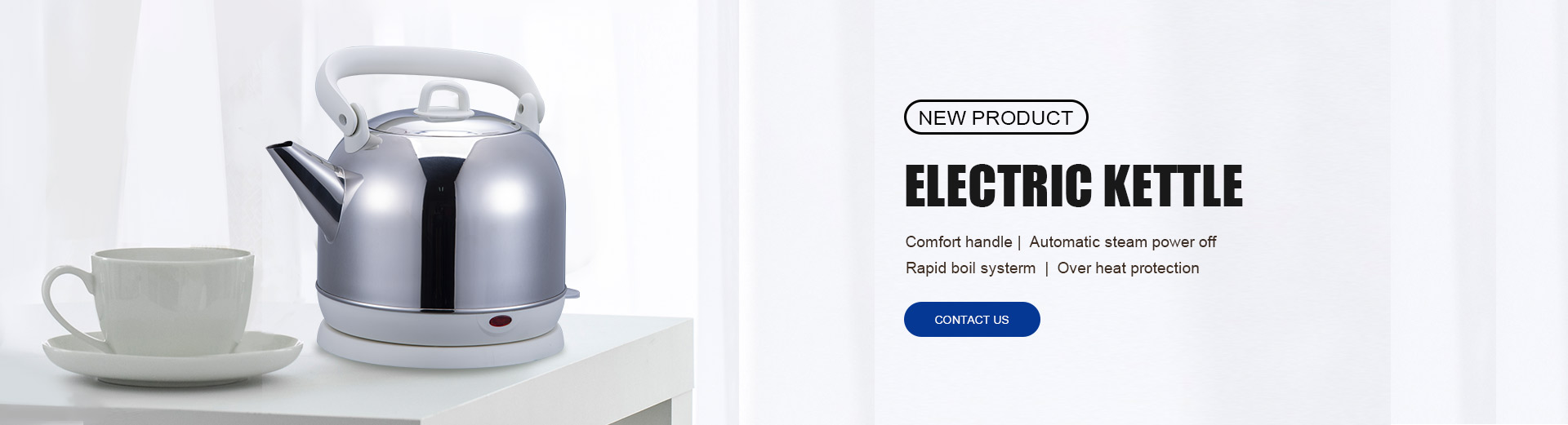
A growing number of travelers, dorm residents, and site staff are using electric kettles for quick “boil-only” cooking when a stove is unavailable. Chicken is one of the most common proteins attempted because boiling water can fully cook it, but results and safety depend heavily on kettle design, material standards, and thermal protections. As a manufacturer focused on stainless steel electric kettles, SHENBAO integrates development, mold design and manufacturing, injection molding, metal stamping, and assembly under an ISO9001 quality management system, with products supported by certifications used in multiple export markets.
Yes, when the kettle is suitable for food-contact boiling and the chicken reaches a safe internal temperature of 75°C or higher. The method is essentially poaching: chicken pieces are fully submerged and cooked by sustained boiling. For operational safety, kettles with concealed heating plates and dry-boil protection are more appropriate than exposed-coil designs because they reduce residue scorching and protect the heating system. SHENBAO’s product line highlights concealed heating element structures and multi-layer safety protection, which directly supports safer boiling-based use.
Cut chicken into small, uniform pieces to shorten boiling time and improve doneness consistency.
Rinse and remove excess fat to reduce oily residue inside the kettle.
Add chicken into the kettle and fill with water until the chicken is fully submerged. Stay below the max fill line.
Switch on and bring to a rolling boil.
Maintain boiling until chicken is fully cooked. Smaller pieces generally cook faster; thicker chunks require longer.
Verify doneness: no pink center, clear juices, and temperature at or above 75°C if you have a probe thermometer.
Pour out contents safely, then rinse immediately to prevent protein film and odor retention.
Rinse while still warm, wipe the inner base, and avoid abrasive tools that could damage the inner surface finish.
If a thin film remains, re-boil clean water once and discard, then rinse again.
When buyers source kettles intended for frequent, high-usage environments such as hospitality rooms, staff housing, or project sites, the supplier type affects risk control.
Direct manufacturer advantages
Process control across mold, plastic parts, metal forming, and assembly enables stable part-fit and heating performance. SHENBAO states it has comprehensive processing capacity covering mold design/manufacturing, injection molding, metal stamping, and assembly.
Quality system and compliance readiness: ISO9001 management plus export-facing certifications and material compliance reporting (including RoHS and LFGB, and WEEE-related implementation statements).
Safety architecture design: triple safety protection concepts are explicitly positioned as product technical advantages.
Typical trader limitations
Less visibility into component-level controls such as thermostat calibration, heating plate specification, and incoming material verification.
Higher batch-to-batch variance if production is frequently switched between factories.
For private label or project-specific kettle programs, an OEM/ODM workflow should be structured to lock down safety and performance early. SHENBAO indicates OEM & ODM support and small batch customization on multiple kettle configurations, including concealed heating element models and large-capacity direct-plug designs.
A practical OEM/ODM sequence for kettle programs:
Requirement definition: capacity, voltage, power, target market compliance, and safety protections.
Appearance and structure selection: single wall vs double wall, concealed heating plate, base type.
Prototype build and validation: boil time, auto shut-off, dry-boil response, leakage checks.
Compliance documentation pack preparation for the destination market.
Pilot run with tightened QC checkpoints before mass production.
When ordering in volume, cost is not just unit price. Evaluate total landed risk:
Power and spec alignment: confirm voltage/power ranges match your distribution region. SHENBAO lists common configurations such as 220–240V and 1850–2200W on multiple large-capacity models.
Capacity planning: align 0.6L travel sizes, 1.7L household, and 3–5L large-kettle needs to your channel mix.
Spare parts strategy: thermostat assemblies, base connectors, lids, and switches should be standardized across SKUs where possible.
Packaging and drop protection: especially for glass models and premium finishes.
Batch consistency: require pre-shipment inspection and retained golden samples.
Use this checklist when qualifying kettle suppliers for retail, hospitality, or project procurement:
| Check item | What to verify | Why it matters |
|---|---|---|
| Factory capability | Mold, injection, metal stamping, assembly in a controlled system | Reduces outsourcing variability |
| Quality system | ISO9001 operation and documented inspection flow | Supports stable mass production |
| Safety protection | Auto steam shut-off, dry-boil protection, fuse-level protection | Reduces incident and warranty risk |
| Material standard | Food-contact inner material and compliant reports for target markets | Reduces regulatory exposure |
| Compliance pack | CE/CB/GS/RoHS/LFGB availability and traceability | Eases import and channel onboarding |
A controlled kettle manufacturing flow typically covers:
Incoming material inspection
Metal forming or stamping for stainless components
Plastic injection for handles, bases, and structural parts
Heating system assembly and wiring
Functional tests for boiling and shut-off behaviors
Final inspection and packing
SHENBAO describes integrated capability across mold, injection molding, stamping, and assembly, supported by testing means and experienced technical and quality teams.
For kettles expected to run reliably in high-frequency use, QC should include:
Insulation resistance and electrical safety checks
Boil time verification under rated voltage
Auto shut-off at boil and dry-boil response testing
Leak check around seams, lid interfaces, and base connectors
Visual inspection for inner surface defects that can trap residue
From a cooking-safety perspective, the key is food-contact surfaces and heat stability. SHENBAO product descriptions emphasize food-grade stainless steel use on multiple models and note 304 stainless steel on certain small kettles.
For overseas distribution, compliance is a make-or-break procurement gate. SHENBAO states it operates ISO9001 and supports certifications such as CE, CB, GS, RoHS, and LFGB, and references WEEE-related implementation statements for regulated markets.
Cooking chicken in an electric kettle is feasible as a boil-only method when you control food safety temperature, use a kettle designed with concealed heating and dry-boil protection, and clean immediately after use. From a supply standpoint, selecting a manufacturer with integrated production capability, documented QC, certified material standards, and export-ready compliance reduces product risk and improves long-run cost control.