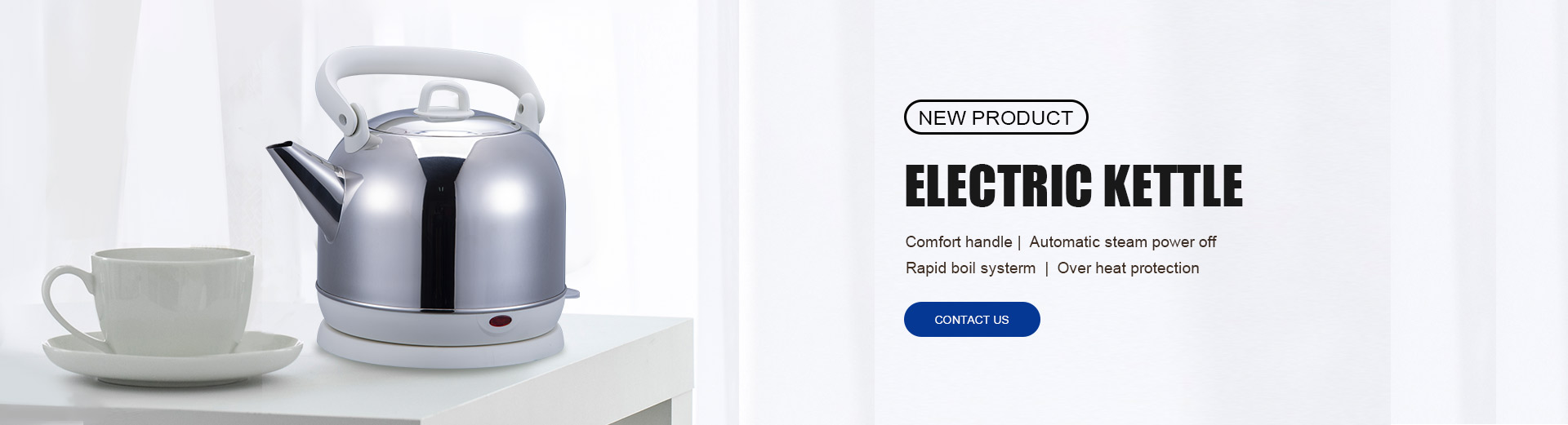
Choosing between a double wall and single wall electric kettle depends on product requirements, usage scenarios, safety expectations, and market positioning. Both designs can provide reliable boiling performance, but their structures create different advantages in insulation, temperature retention, durability, and user experience.
From a manufacturer’s perspective, electric kettle structure design involves more than appearance. It requires careful consideration of material selection, heat transfer efficiency, safety protection, production processes, and quality control.
According to energy efficiency studies from international appliance research organizations, improving heat retention and reducing unnecessary heat loss can help improve appliance efficiency. For electric kettle manufacturers, structural design plays an important role in balancing performance and energy consumption.
The main difference between double wall and single wall kettles is the internal structure.
| Feature | double wall electric kettle | Single Wall Electric Kettle |
|---|---|---|
| Structure | Two-layer body design | Single-layer body design |
| Heat retention | Better insulation performance | Faster heat release |
| Exterior temperature | Lower surface temperature | Higher surface temperature |
| Safety | Suitable for families and offices | Requires more careful handling |
| Application | Premium household and commercial use | General kitchen applications |
Both structures can be developed with reliable heating performance when manufactured with proper engineering.
double wall electric kettles use an additional insulation layer between the inner and outer walls.
The double-layer structure reduces heat transfer to the external surface, helping maintain water temperature for longer periods.
Because the outer surface remains cooler, double wall kettles provide better protection during daily use.
The enhanced structure makes double wall kettles suitable for customers looking for improved safety, comfort, and modern design.
The insulation structure helps improve thermal efficiency by reducing unnecessary heat dissipation.
SHENBAO specializes in research, development, manufacturing, and sales of stainless steel electric kettles, double wall anti-hot kettles, plastic kettles, and other stainless steel products. The company develops electric kettle solutions with different structures and functions for global markets. (SHENBAO)
For applications requiring insulation performance, the Double Wall Kettle with Temperature Control provides a double-layer structure combined with temperature management functions.
Single wall electric kettles remain popular because of their simple structure and cost efficiency.
Main advantages include:
Lightweight design
Simple manufacturing structure
Efficient heating performance
Easy production customization
Single wall designs are suitable for applications where fast boiling and practical operation are the main requirements.
Choosing between double wall and single wall designs depends on several factors.
Manufacturers evaluate:
| Evaluation Factor | Purpose |
|---|---|
| Target application | Determines product structure |
| Safety requirements | Influences insulation design |
| Capacity | Affects heat management |
| Market positioning | Determines product features |
| Cost requirements | Supports product planning |
A professional electric kettle manufacturer considers the complete product lifecycle when developing different structures.
Material selection is essential for both double wall and single wall kettles.
Important considerations include:
| Material Requirement | Purpose |
|---|---|
| Stainless steel quality | Provides durability |
| Food-grade materials | Ensure safe water contact |
| Heat-resistant components | Improve safety |
| Electrical materials | Support stable operation |
High-quality materials help kettles maintain reliable performance during repeated heating cycles.
SHENBAO implements ISO9001 quality management systems, and its products have obtained CE, CB, GS, ROHS, and LFGB certifications to support international market requirements. (SHENBAO)
The final performance of an electric kettle depends on precise manufacturing control.
The production process includes:
Product design
Material inspection
Mold development
Stainless steel processing
Metal stamping
Injection molding
Component assembly
Electrical testing
Final inspection
Quality control checkpoints include:
| Inspection Stage | Purpose |
|---|---|
| Material inspection | Verify raw materials |
| Structural testing | Confirm product durability |
| Heating testing | Check performance |
| Electrical safety testing | Ensure safe operation |
| Final inspection | Maintain product consistency |
SHENBAO has comprehensive production capabilities including mold design and manufacturing, injection molding, metal stamping, and assembly, allowing better control over product quality. (SHENBAO)
Different markets require different kettle structures, capacities, designs, and functions.
A professional manufacturer can support:
Structural design
Material selection
Prototype development
Function testing
Customized production
The OEM and ODM process usually includes:
Requirement analysis
Product design
Sample confirmation
Testing process
Mass production
SHENBAO provides customized electric kettle solutions according to customer requirements, supporting different product development projects. (SHENBAO)
For large-volume orders, production consistency and structural reliability are important.
A project sourcing checklist should include:
| Evaluation Item | Purpose |
|---|---|
| Factory capability | Support production volume |
| Quality management | Maintain consistency |
| Testing equipment | Verify product performance |
| Certification support | Meet market standards |
| Export experience | Support international delivery |
SHENBAO electric kettle products are exported to Europe, Southeast Asia, the Middle East, South America, and other overseas markets. (SHENBAO)
Electric kettles must meet different safety and compliance requirements depending on the destination market.
Manufacturers need to manage:
Electrical safety standards
Material compliance
Product testing
Certification requirements
Packaging standards
Professional manufacturers ensure these requirements are controlled throughout product development and production.
Double wall and single wall electric kettles both have advantages. Double wall kettles provide better insulation and improved safety, while single wall kettles offer a simpler structure and practical performance.
The best choice depends on application requirements, market positioning, and customer expectations. However, reliable performance always depends on professional design, quality materials, and strict manufacturing control.
With integrated R&D, manufacturing capabilities, quality management systems, and OEM/ODM experience, SHENBAO provides electric kettle solutions designed for global markets.