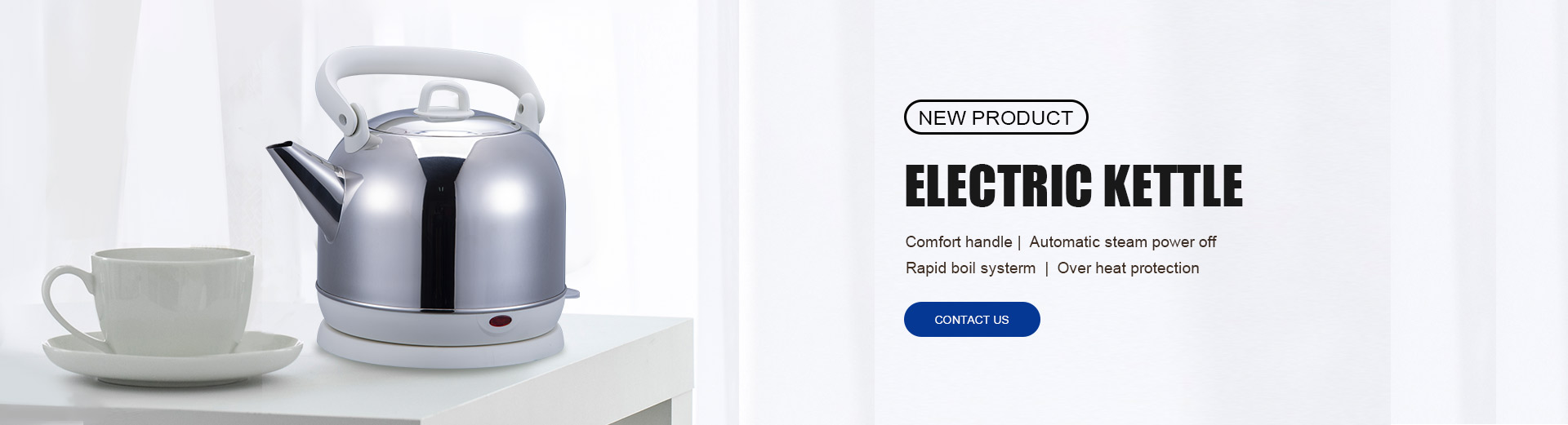
Custom kettle production requires more than a product idea or a simple design drawing. A professional custom kettle manufacturer needs detailed information about product requirements, materials, functions, appearance, certifications, and production expectations before starting development.
Clear communication at the beginning of an OEM or ODM project helps manufacturers evaluate feasibility, control production costs, shorten development time, and ensure the final product meets market requirements.
SHENBAO specializes in the research, development, and manufacturing of stainless steel electric kettles, double wall anti-hot kettles, plastic kettles, and related stainless steel products. The factory has integrated capabilities including mold design and manufacturing, injection molding, metal stamping, assembly, and quality management. :contentReference[oaicite:0]{index=0}
The first information a factory needs is a clear understanding of the product concept.
Before starting a custom electric kettle project, manufacturers usually need to know:
| Information | Why It Matters |
|---|---|
| Product type | Determines production method and structure |
| Target application | Defines function and durability requirements |
| Market positioning | Influences material and design choices |
| Expected quantity | Helps plan production capacity |
| Target price range | Guides cost optimization |
For example, a kettle designed for household use may focus on appearance and convenience, while a commercial kettle may require higher capacity, stronger structure, and longer operating life.
SHENBAO provides different kettle solutions, including Stainless Steel Kettles, double wall kettles, Glass Kettles, and traditional large kettles, supporting different application requirements. :contentReference[oaicite:1]{index=1}
A factory needs accurate product information before creating samples.
Useful design materials include:
Product drawings
3D files
Reference samples
Size requirements
Functional descriptions
Appearance preferences
If customers only provide a basic concept, an experienced ODM manufacturer can help optimize the structure and manufacturing solution.
The design evaluation stage usually focuses on:
| Design Area | Manufacturing Consideration |
|---|---|
| Product shape | Whether it can be formed efficiently |
| Structure | Assembly feasibility |
| Components | Compatibility between parts |
| Appearance | Surface treatment possibilities |
A manufacturer does not only copy a design. A professional factory evaluates whether the design can achieve stable mass production.
Material selection directly affects kettle quality, durability, and market acceptance.
For stainless steel kettles, manufacturers need to confirm:
Stainless steel grade
Material thickness
Surface finishing requirements
Food contact requirements
Corrosion resistance expectations
Common material options include:
| Material | Features |
|---|---|
| 304 Stainless Steel | Good corrosion resistance and widely used |
| Double Wall Stainless Steel | Better heat insulation performance |
| Food Grade Plastic | Used for handles and external components |
Material standards are especially important for export markets because different regions may have different safety requirements.
SHENBAO focuses on stainless steel electric kettle production and applies strict quality management systems. Its products have obtained certifications including CE, CB, GS, ROHS, and LFGB according to different product requirements. :contentReference[oaicite:2]{index=2}
Manufacturers need clear information about product functions before development.
Important details include:
Capacity
Voltage
Power
Heating method
Temperature control
Safety functions
Plug type
Example:
| Feature | Production Impact |
|---|---|
| Temperature control | Requires additional control components |
| Double wall structure | Changes product assembly process |
| Large capacity | Requires stronger body structure |
| Hidden heating element | Influences internal design |
For electric kettles, safety functions are especially important. SHENBAO products include safety designs such as automatic steam power off, dry burning power off, and high temperature fuse protection. :contentReference[oaicite:3]{index=3}
OEM kettle production usually involves different levels of customization.
A factory needs to know whether customization includes:
Logo printing
Color changes
Surface finishing
Handle design
Packaging design
New product structure
| Customization Level | Factory Preparation |
|---|---|
| Existing model modification | Adjust production details |
| Appearance customization | Evaluate molds and materials |
| New structure development | Require engineering review |
| Complete ODM project | Full development process |
Understanding customization requirements early helps manufacturers estimate tooling costs, sample time, and production schedules.
Order quantity is another key factor for custom kettle production.
Factories need information about:
Trial order quantity
Annual demand forecast
Delivery schedule
Market launch plan
Different order volumes may affect:
Mold investment
Material purchasing
Production arrangement
Unit cost
A clear bulk supply plan allows manufacturers to prepare production resources more efficiently.
Different markets have different compliance requirements.
Before production, manufacturers need to confirm:
Destination country
Required certifications
Testing standards
Packaging requirements
Documentation needs
Common requirements may include:
| Market Requirement | Purpose |
|---|---|
| CE | European safety requirements |
| CB | International electrical safety system |
| GS | German safety certification |
| ROHS | Restriction of hazardous substances |
| LFGB | Food contact requirements |
Understanding export requirements before production prevents delays during product approval and shipment.
A reliable factory needs to understand quality expectations before mass production.
Important quality information includes:
Appearance standards
Functional testing requirements
Inspection methods
Defect acceptance standards
Packaging protection requirements
A complete quality control process usually covers:
| Production Stage | Inspection Focus |
|---|---|
| Raw material | Verify specifications |
| Mold and tooling | Confirm accuracy |
| Sample stage | Check product performance |
| Mass production | Maintain consistency |
| Final inspection | Approve shipment |
SHENBAO has experienced technical and quality management teams with advanced equipment and testing methods to support stable production. :contentReference[oaicite:4]{index=4}
When developing a custom kettle, providing complete information directly to a manufacturer creates better communication efficiency.
A direct factory can participate in:
Product design evaluation
Engineering improvement
Production planning
Quality control
Cost optimization
Compared with a trader coordinating multiple suppliers, working with a manufacturer allows technical discussions to happen directly with the production team.
Before starting production, prepare:
| Category | Required Information |
|---|---|
| Product | Type and application |
| Design | Drawings or samples |
| Material | Stainless steel and component requirements |
| Function | Capacity, power, safety features |
| Customization | Logo, color, packaging |
| Quantity | Order volume and schedule |
| Compliance | Required certifications |
| Quality | Inspection standards |
Successful OEM and ODM kettle production starts with accurate project information. The more details provided during the early stage, the easier it becomes for manufacturers to optimize design, control costs, and maintain production quality.
A capable custom kettle manufacturer should provide support from product evaluation and engineering development to mass production and quality inspection.
With integrated manufacturing capabilities, mold development, injection molding, metal stamping, assembly, and certification experience, SHENBAO provides reliable custom electric kettle manufacturing solutions for global markets.