An electric kettle that suddenly stops working can interrupt daily routines and may indicate issues related to power connection, internal components, safety protection, or product maintenance. Understanding the possible causes helps users identify problems and also shows why manufacturing quality is essential for long-term product reliability.
From a manufacturer’s perspective, an electric kettle not turning on is not only a user experience issue but also a reflection of electrical design, component selection, production control, and safety testing. A reliable electric kettle requires stable electrical systems, durable materials, and strict quality management.
According to electrical appliance safety guidelines, household appliances require careful control of electrical components and protection systems to reduce operational risks. For electric kettle manufacturers, product safety and reliability must be considered throughout the entire manufacturing process.
Several factors can prevent an electric kettle from operating.
| Possible Cause | Description |
|---|---|
| Power connection problem | Electricity cannot reach the kettle |
| Damaged power base | Prevents electrical connection |
| Safety protection activation | Stops operation under abnormal conditions |
| Internal component failure | Affects electrical function |
| Switch or control issue | Prevents startup |
Checking these factors can help identify whether the issue comes from external conditions or internal components.
Before replacing a kettle, several simple checks can be performed.
Confirm that the electrical outlet works properly and that the power connection is stable.
For cordless electric kettles, the connection between the kettle and base is important for electrical transfer.
Many modern electric kettles include automatic shut-off and dry boil protection systems. These features may temporarily stop operation when abnormal conditions occur.
Damage, overheating, or long-term wear may affect internal performance.
For manufacturers, preventing these problems starts with reliable product design and strict production control.
A high-quality electric kettle depends on the cooperation of multiple components, including heating elements, temperature controllers, switches, and safety systems.
Important design considerations include:
Stable electrical connections
Reliable temperature control
Safety protection systems
Durable materials
Consistent manufacturing quality
SHENBAO specializes in research, development, manufacturing, and sales of stainless steel electric kettles, double wall anti-hot kettles, plastic kettles, and other stainless steel products. The company integrates design, manufacturing, and quality management to provide reliable electric kettle solutions for global markets. (SHENBAO)
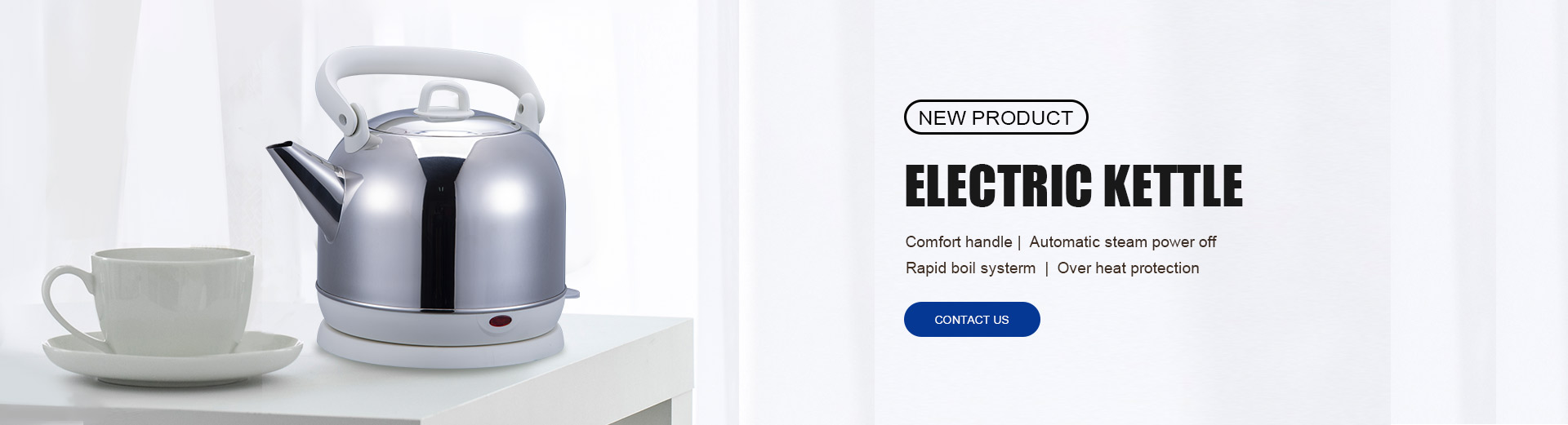
For users requiring stable operation and safety protection, the Stainless Steel Kettle with Automatic Shut-off provides automatic control functions and durable stainless steel construction.
Material quality directly affects product safety and service life.
Manufacturers usually evaluate:
| Material Component | Function |
|---|---|
| Stainless steel body | Provides durability and corrosion resistance |
| Food-grade inner materials | Supports safe water contact |
| Heat-resistant plastic | Improves insulation |
| Electrical components | Controls operation and safety |
Suitable materials help electric kettles maintain stable performance during repeated heating cycles.
SHENBAO implements ISO9001 quality management systems, and its products have obtained CE, CB, GS, ROHS, and LFGB certifications to support different international market requirements. (SHENBAO)
Product reliability depends on every stage of manufacturing.
The production process usually includes:
Product design
Mold development
Stainless steel processing
Metal stamping
Injection molding
Component assembly
Electrical testing
Final inspection
Quality control checkpoints include:
| Inspection Stage | Purpose |
|---|---|
| Material inspection | Confirm raw material quality |
| Component testing | Verify electrical reliability |
| Assembly inspection | Ensure accurate installation |
| Safety testing | Confirm operational protection |
| Final inspection | Maintain product consistency |
SHENBAO has comprehensive production capabilities including mold design and manufacturing, injection molding, metal stamping, and assembly, allowing better control over product quality. (SHENBAO)
Different markets require different product designs, capacities, functions, and electrical specifications.
A professional manufacturer can support:
Product design
Engineering development
Prototype testing
Function optimization
Customized production
The OEM and ODM process usually includes:
Requirement analysis
Design development
Prototype confirmation
Testing process
Mass production
SHENBAO provides customized electric kettle solutions according to customer requirements, supporting different product development needs. (SHENBAO)
For large-volume electric kettle orders, production consistency and quality control are essential.
Important evaluation factors include:
| Evaluation Item | Purpose |
|---|---|
| Factory capability | Support production demand |
| Quality system | Maintain stable quality |
| Testing equipment | Verify product performance |
| Certification support | Meet market requirements |
| Export experience | Support global delivery |
SHENBAO electric kettle products are exported to Europe, Southeast Asia, the Middle East, South America, and other overseas markets. (SHENBAO)
Electric kettles require strict management of safety and compliance requirements.
Manufacturers need to consider:
Electrical safety standards
Voltage compatibility
Material compliance
Product certification
Export documentation
Professional manufacturers manage these requirements throughout development and production.
An electric kettle not turning on may be caused by simple connection problems or internal component issues. However, long-term product reliability depends on engineering design, material selection, manufacturing accuracy, and quality control.
Choosing an experienced electric kettle manufacturer helps ensure stable performance, reliable safety, and customized solutions for different markets.
With integrated R&D, manufacturing capabilities, quality management systems, and OEM/ODM experience, SHENBAO provides stainless steel electric kettle solutions designed for global markets.