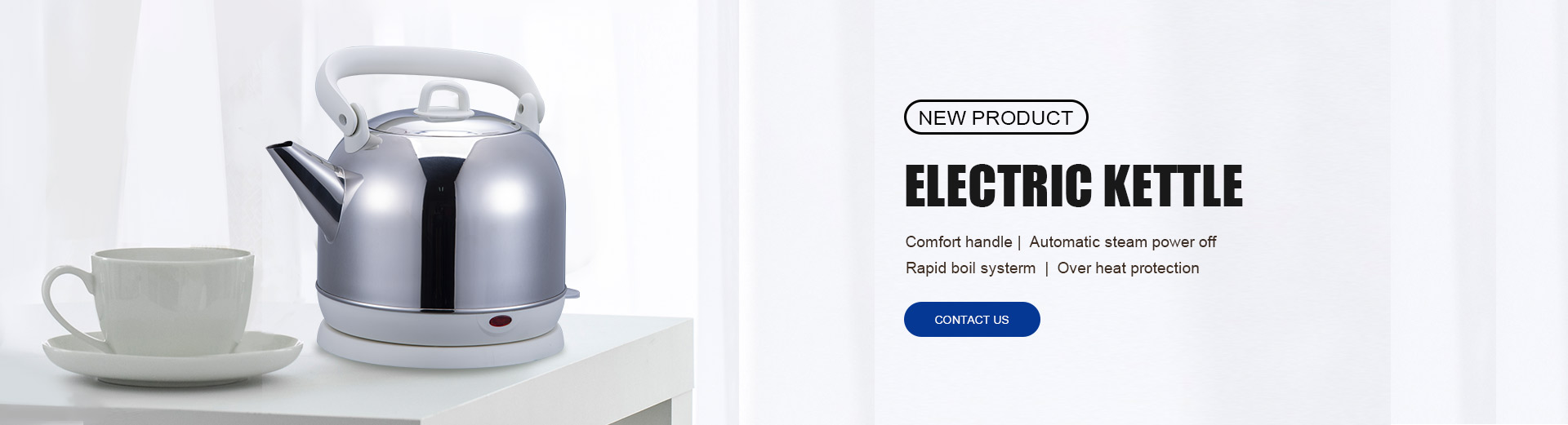
kettle customization requires careful consideration of design structure, material selection, safety standards, manufacturing feasibility, and user experience to create reliable products.
Customized electric kettles involve more than changing colors or adding logos. A successful customization project requires coordination between industrial design, engineering development, production processes, and quality control.
Many design ideas may look attractive during the concept stage but face challenges when transferred into mass production. Factors such as material compatibility, component integration, production efficiency, and safety requirements must be evaluated before manufacturing begins.
Professional electric kettle manufacturers usually consider:
Product positioning and target market
Functional requirements
Material selection
Manufacturing processes
Certification requirements
Long-term product reliability
A well-planned design process helps avoid production problems and ensures that customized kettles maintain consistent quality during large-scale manufacturing.
Structural design is one of the biggest challenges in kettle customization because every component needs to work together as a complete system.
An electric kettle includes multiple parts such as:
Stainless steel or glass body
Heating system
Handle
Lid
Spout
Control base
Internal electrical components
Changing one part may influence other components. For example, increasing kettle capacity may require adjustments to handle strength, heating power, body dimensions, and overall weight balance.
Manufacturers need to optimize the structure to achieve both attractive appearance and reliable performance.
Material selection directly affects product appearance, safety, durability, and production cost.
Common customization challenges include:
Different materials create different visual and functional effects. Stainless steel provides durability and a premium appearance, while glass offers transparency and modern styling.
The selected materials must match:
Product design concept
Usage environment
Target market expectations
Manufacturing capabilities
Materials used in electric kettles must meet relevant safety requirements, especially components that contact water or operate under high temperatures.
Manufacturers need to evaluate:
Heat resistance
Chemical stability
Food-contact safety
Long-term performance
Customized materials may require special processing methods. Without proper manufacturing control, differences in texture, color, or surface quality may appear between production batches.
One of the most important challenges in kettle customization is balancing creative design with practical manufacturing.
A design may require:
Complex molding structures
Special surface treatments
Additional assembly steps
Customized components
While these features may improve product differentiation, they can also increase production difficulty and affect delivery schedules.
Experienced manufacturers evaluate designs from a production perspective to determine whether they can be efficiently manufactured while maintaining quality standards.
Safety is a critical consideration in electric kettle customization because the product involves electricity, heating elements, and hot water.
Key safety design factors include:
The heating system, power connection, and control components must be properly integrated to ensure stable operation.
The design should prevent excessive heat transfer to user-contact areas such as handles and buttons.
The kettle body, lid, and base need sufficient strength to withstand daily operation and transportation conditions.
Manufacturers typically conduct design reviews and product testing to identify potential risks before mass production.
A customized kettle must not only look different but also provide a better user experience.
Important design considerations include:
| Design Element | User Experience Impact |
|---|---|
| Handle shape | Improves grip comfort and pouring control |
| Lid structure | Affects filling convenience and cleaning |
| Spout design | Influences water flow accuracy |
| Weight balance | Reduces operating fatigue |
| Button position | Improves daily usability |
Small details often determine how users evaluate product quality after purchase.
Surface finishing is an important design element but requires precise manufacturing control.
Different finishes, such as:
Brushed stainless steel
Mirror polishing
Matte surfaces
Colored coatings
have different processing requirements.
Challenges may include:
Maintaining consistent texture
Preventing surface defects
Ensuring coating durability
Matching different components
For large-volume OEM and ODM projects, finish consistency is essential because customers expect every product to maintain the same appearance.
Customization often involves finding the right balance between product uniqueness and manufacturing efficiency.
A highly complex design may increase:
Mold investment
Production time
Assembly difficulty
Quality inspection requirements
Manufacturers need to evaluate whether each design feature creates enough market value to justify additional production requirements.
The most effective customized kettle designs usually combine distinctive appearance with practical manufacturing solutions.
OEM and ODM experience helps manufacturers identify potential design challenges early and provide practical solutions.
A complete customization process usually includes:
Product concept evaluation
Structural design optimization
Material and finish selection
Prototype testing
Production process adjustment
Quality verification
Manufacturers with integrated development and production capabilities can support customers from initial ideas to finished products while reducing unnecessary design risks.
Electric kettle customization is a complex process that requires coordination between creativity, engineering, manufacturing, and quality control.
The biggest design challenges are not only about creating a unique appearance but also ensuring safety, durability, production efficiency, and user satisfaction.
Through professional design evaluation, advanced manufacturing processes, and strict quality management, customized electric kettles can achieve market differentiation while maintaining reliable performance.