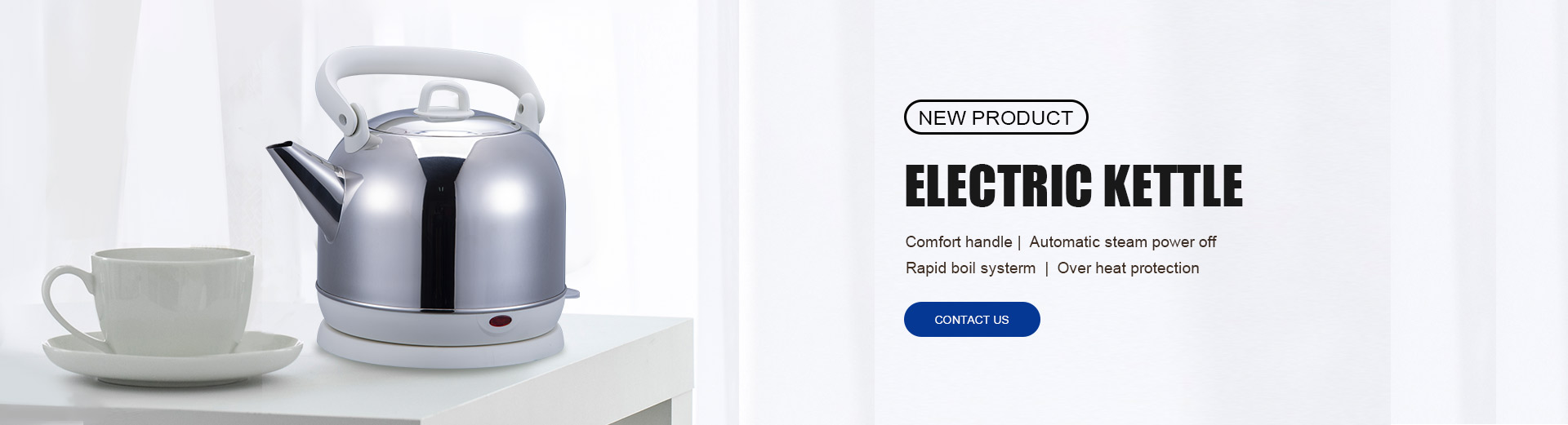
Manufacturers control welding quality in electric kettle production through precise welding processes, skilled operation, equipment management, and strict inspection procedures.
Welding is a critical process in electric kettle production because it directly affects structural strength, water-tightness, appearance quality, and long-term reliability.
Stainless Steel Kettles often require welding during the manufacturing of components such as the kettle body, internal structures, and connecting parts. Poor welding quality may lead to problems including leakage, weak joints, surface defects, or reduced product lifespan.
Professional manufacturers focus on welding quality control to ensure:
Strong and stable connections
Smooth product appearance
Reliable water containment
Consistent performance during mass production
A controlled welding process helps transform stainless steel components into safe and durable electric kettle products.
Different welding methods may be selected according to kettle structure, material characteristics, and production requirements.
Common welding processes include:
Laser welding uses concentrated energy to create precise connections with minimal material deformation.
Advantages include:
High welding accuracy
Clean welding appearance
Strong joint consistency
Suitable for precision components
TIG welding provides accurate control and is often used when appearance quality and welding precision are important.
Benefits include:
Smooth welding results
Good control of heat input
High-quality stainless steel connections
Automation helps improve welding consistency during large-volume production by reducing variations caused by manual operations.
The appropriate welding method depends on product design, production volume, and quality requirements.
Proper preparation is essential for achieving stable welding quality.
Before welding, manufacturers typically control:
Stainless steel materials are checked for:
Material specifications
Surface condition
Thickness consistency
Contaminants such as oil, dust, or oxidation can affect welding performance. Proper cleaning helps improve joint quality.
Accurate positioning ensures that welding areas match correctly and reduces structural stress.
Good preparation creates a reliable foundation for the welding process.
Welding quality depends heavily on controlling key process parameters.
Important factors include:
| Welding Parameter | Quality Impact |
|---|---|
| Heat input | Affects material deformation and joint strength |
| Welding speed | Influences consistency and appearance |
| Welding position | Determines connection accuracy |
| Equipment settings | Maintains stable production results |
Professional manufacturers establish standardized welding procedures to ensure every product follows consistent processing requirements.
Advanced welding equipment plays an important role in maintaining stable production quality.
Modern equipment helps improve:
Welding accuracy
Process repeatability
Production efficiency
Defect reduction
Regular equipment maintenance is also necessary because worn or incorrectly calibrated equipment can affect welding results.
Manufacturers usually perform routine checks to ensure machines continue operating within required parameters.
Welding defects can affect both appearance and product performance. Preventive control is therefore an important part of production management.
Common welding issues include:
Poor welding connections may create weak points that allow water leakage.
Manufacturers prevent this through:
Proper welding procedures
Accurate component positioning
Water-tightness testing
Uneven welding may affect the appearance of stainless steel kettles.
Control methods include:
Stable welding parameters
Skilled operation
Surface finishing inspection
Insufficient welding strength may reduce product durability.
Manufacturers improve reliability through process control and strength verification.
Welding quality requires inspection at different production stages.
Common inspection methods include:
Operators check:
Weld appearance
Surface smoothness
Connection consistency
Finished components are tested to confirm water-tight performance.
Testing evaluates whether welded areas can withstand daily operating conditions.
Samples from production batches are inspected to ensure consistent quality.
These inspection methods help identify potential problems before products reach customers.
Welding quality depends not only on equipment but also on manufacturing experience.
Experienced production teams understand how different factors influence welding performance, including:
Stainless steel characteristics
Product structure
Heat control requirements
Surface finishing needs
Manufacturing experience helps optimize welding processes and reduce unnecessary production issues.
For OEM and ODM electric kettle projects, maintaining the same welding quality across large quantities is a major challenge.
Manufacturers improve consistency through:
Standardized welding procedures
Operator training
Equipment calibration
Process documentation
Quality inspection systems
A stable production system ensures that every batch meets the same quality expectations.
Welding quality is closely connected with overall product safety.
Reliable welding helps ensure:
No water leakage during operation
Strong product structure
Better resistance to daily use
Longer service life
For electric kettles, welding is not only a manufacturing step but also an important safety control point.
Welding quality control determines whether stainless steel kettle components can achieve the required strength, appearance, and reliability.
Through suitable welding technology, accurate process control, advanced equipment, and strict inspection systems, manufacturers can produce electric kettles that deliver safe operation and consistent performance.
Professional welding management is an important foundation for creating durable electric kettle products for global markets.