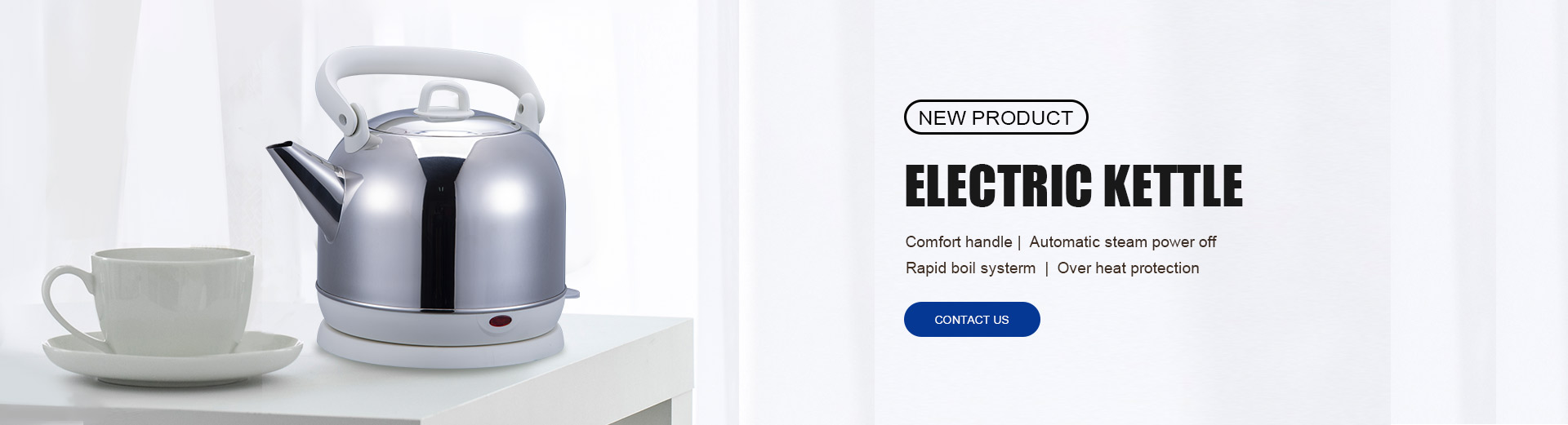
Injection molding is important in electric kettle manufacturing because it enables precise production of plastic components, improves consistency, supports customization, and enhances overall product reliability.
Electric kettles are not made entirely from metal. Many important components require engineering plastics to achieve heat resistance, insulation, lightweight structures, and ergonomic designs.
Injection molding is a manufacturing process that uses heated plastic materials injected into molds to create precise components with consistent dimensions.
In electric kettle production, injection molding is commonly used for:
Handles
Lids
Base housings
Switch components
Decorative covers
Internal plastic structures
The process allows manufacturers to produce complex shapes efficiently while maintaining stable quality during large-volume production.
Injection molding plays an important role in producing many kettle components that directly influence user experience and product performance.
Handles require precise molding because they must provide:
Comfortable grip
Structural strength
Heat insulation
Stable connection with the kettle body
Injection molding helps create ergonomic handle designs while maintaining consistent dimensions across production batches.
Lids require accurate fitting to ensure smooth operation and proper sealing.
Injection molding supports:
Complex shapes
Precise assembly points
Improved appearance quality
Reliable opening and closing performance
The bottom base often contains electrical connections and control structures.
Injection molding helps produce housings with:
Accurate internal spaces
Good electrical insulation
Stable component integration
Injection molding improves kettle quality by providing high precision and repeatability.
Key benefits include:
Mold-based production ensures that thousands of parts maintain similar sizes and shapes, improving assembly accuracy.
Precisely molded plastic components fit better with stainless steel bodies and electrical systems.
Injection molding creates smooth surfaces and supports different textures, colors, and design details.
For customized electric kettles, consistent molding quality helps maintain the intended product appearance and performance.
The quality of injection molded parts depends heavily on selecting suitable engineering plastics.
Common material requirements include:
Heat resistance
Mechanical strength
Impact resistance
Chemical stability
Long-term durability
Different components may require different plastic characteristics.
For example:
| Component | Important Material Properties |
|---|---|
| Handle | Heat resistance and mechanical strength |
| Base housing | Electrical insulation and stability |
| Lid components | Dimensional accuracy and durability |
| Buttons | Wear resistance and reliable operation |
Professional manufacturers select materials based on component function and operating conditions.
Injection molding provides strong customization flexibility for electric kettle development.
Manufacturers can customize:
Component shapes
Product colors
Surface textures
Brand design elements
Structural details
Through customized molds, brands can create unique kettle designs that match specific market positioning.
For OEM and ODM projects, injection molding allows manufacturers to turn product concepts into practical mass-production solutions.
The injection mold is one of the most important factors affecting molded component quality.
A high-quality mold helps achieve:
Accurate dimensions
Smooth surfaces
Stable production cycles
Reduced defects
Mold development requires careful consideration of:
Component structure
Plastic flow behavior
Cooling efficiency
Production volume
For customized kettle projects, proper mold design helps balance product innovation and manufacturing efficiency.
Injection molding is highly suitable for large-scale electric kettle production because it enables automated and repeatable manufacturing.
Advantages include:
Faster production cycles
Reduced manual processing
Lower component variation
Efficient material usage
For manufacturers producing large quantities of electric kettles, injection molding helps maintain stable output while controlling production costs.
Quality control is essential because molded plastic components affect both appearance and function.
Manufacturers typically inspect:
Components are checked to ensure they match design specifications.
Inspections identify:
Scratches
Flow marks
Color differences
Surface defects
Molded parts are tested with other kettle components to ensure proper fitting.
Plastic materials are evaluated for heat resistance and durability.
These controls help ensure reliable performance in finished electric kettles.
Injection molding is one part of a complete electric kettle manufacturing system.
It works together with:
| Process | Connection With Injection Molding |
|---|---|
| Metal forming | Creates Stainless Steel Kettle structures |
| Assembly | Combines plastic and metal components |
| Surface treatment | Enhances external appearance |
| Testing | Verifies finished product reliability |
The cooperation between different processes determines the final quality of the kettle.
Manufacturers improve injection molding quality through:
Advanced molding equipment
Professional mold maintenance
Process parameter control
Material management
Production inspection
Important molding parameters include:
Injection temperature
Pressure control
Cooling time
Mold conditions
Stable process management helps reduce defects and maintain consistent product quality.
Injection molding directly influences electric kettle design flexibility, production efficiency, and product reliability.
Manufacturers with strong injection molding capabilities can develop more complex designs, improve component quality, and support customized product requirements.
By combining suitable materials, precise molds, and strict quality control, electric kettle manufacturers can create products with better appearance, safer structures, and reliable performance for global markets.