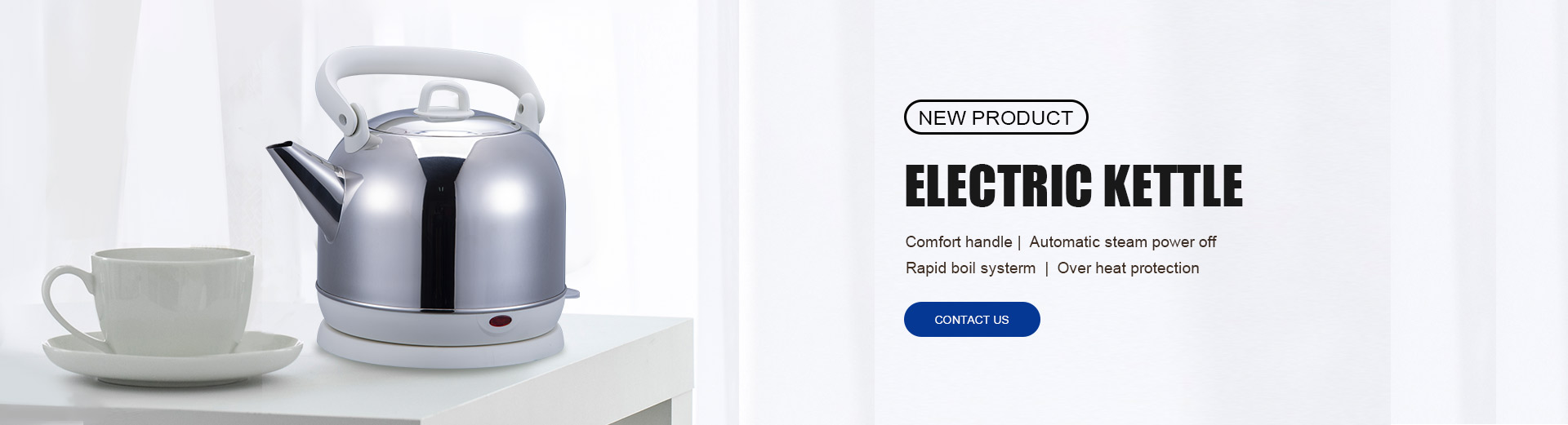
Metal stamping improves electric kettle production by creating accurate metal components, increasing manufacturing efficiency, and ensuring consistent product structures.
Metal stamping is a key manufacturing process used to shape stainless steel components for electric kettles. By applying controlled pressure through specialized molds, flat metal sheets can be transformed into precise parts required for kettle structures.
In electric kettle production, stamping affects:
Product dimensional accuracy
Structural strength
Production efficiency
Material utilization
Manufacturing consistency
For Stainless Steel Kettles, precise stamping helps create components that fit correctly during assembly while maintaining a stable appearance and reliable performance.
Metal stamping is widely used to manufacture different electric kettle components.
Common stamped parts include:
The stainless steel body is one of the most important parts affected by forming processes. Stamping helps create smooth and consistent shapes while maintaining structural strength.
Stamped bottom components provide support for:
Heating systems
Electrical connections
Base assembly
Accurate dimensions are important because the bottom structure directly affects the connection between the kettle body and power base.
Certain internal supports and structural components can also be produced through stamping to improve assembly efficiency.
One of the biggest advantages of metal stamping is its ability to support high-volume manufacturing.
Compared with manual metal forming, stamping provides:
Faster production cycles
Higher repeatability
Lower material waste
More consistent component quality
For OEM and ODM electric kettle projects, efficient stamping processes help manufacturers meet large production requirements while maintaining stable quality.
Precision is essential in electric kettle manufacturing because multiple components must work together accurately.
Accurate stamping improves:
Precisely formed parts fit better during assembly, reducing gaps and alignment issues.
Consistent dimensions help maintain stronger connections between components.
Smooth and accurate metal forming improves the overall visual quality of stainless steel kettles.
Small dimensional differences during stamping can influence later processes such as welding, polishing, and assembly.
The stamping process affects the strength and reliability of stainless steel kettle structures.
A controlled stamping process helps achieve:
Strong metal structures
Reduced deformation risks
Stable product shape
Better resistance during daily use
Proper process control is important because excessive pressure or incorrect forming parameters may create material stress or surface defects.
Professional manufacturers optimize stamping conditions according to stainless steel characteristics and product design requirements.
Although stamping improves production efficiency, manufacturers must manage several technical challenges.
Stainless steel requires proper forming parameters to prevent:
Cracks
Wrinkles
Uneven surfaces
Stamping quality depends heavily on mold accuracy. Poor mold conditions can affect component dimensions and production consistency.
Metal surfaces must be protected during stamping to prevent scratches or defects that may affect later finishing processes.
Experienced manufacturers combine suitable equipment, mold management, and process monitoring to reduce these challenges.
Stamping molds determine the shape, accuracy, and repeatability of metal components.
High-quality molds help improve:
Production stability
Component consistency
Processing efficiency
Product quality
For customized electric kettles, mold development is especially important because unique product designs may require specially developed tooling.
Manufacturers evaluate mold structure and production requirements before starting mass production.
Quality control is integrated throughout the stamping process.
Important inspection steps include:
Raw stainless steel sheets are checked for thickness, quality, and suitability.
Initial stamped components are inspected to confirm mold accuracy and process settings.
Production parameters are monitored to maintain consistent results.
Stamped parts are checked for:
Dimensions
Surface condition
Structural accuracy
These controls help ensure that every batch meets manufacturing requirements.
Metal stamping provides flexibility for customized kettle development.
Manufacturers can adjust:
Body shapes
Component dimensions
Structural designs
Metal appearance requirements
For OEM and ODM projects, stamping capability allows manufacturers to transform unique designs into practical production solutions.
A strong stamping process helps balance creative product development with reliable mass production.
Metal stamping is one part of a complete electric kettle manufacturing system.
It works together with:
| Manufacturing Process | Relationship With Stamping |
|---|---|
| Welding | Joins stamped metal components |
| Surface finishing | Improves appearance after forming |
| Assembly | Integrates stamped parts with other components |
| Quality testing | Verifies final product performance |
The combination of these processes determines the final quality of the electric kettle.
Metal stamping directly influences production efficiency, component accuracy, and product reliability.
Manufacturers with strong stamping capabilities can better control product quality, support customization requirements, and improve manufacturing consistency.
By combining precision tooling, advanced equipment, and strict process management, electric kettle manufacturers can produce stainless steel kettles with reliable structures, attractive designs, and stable performance for global markets.