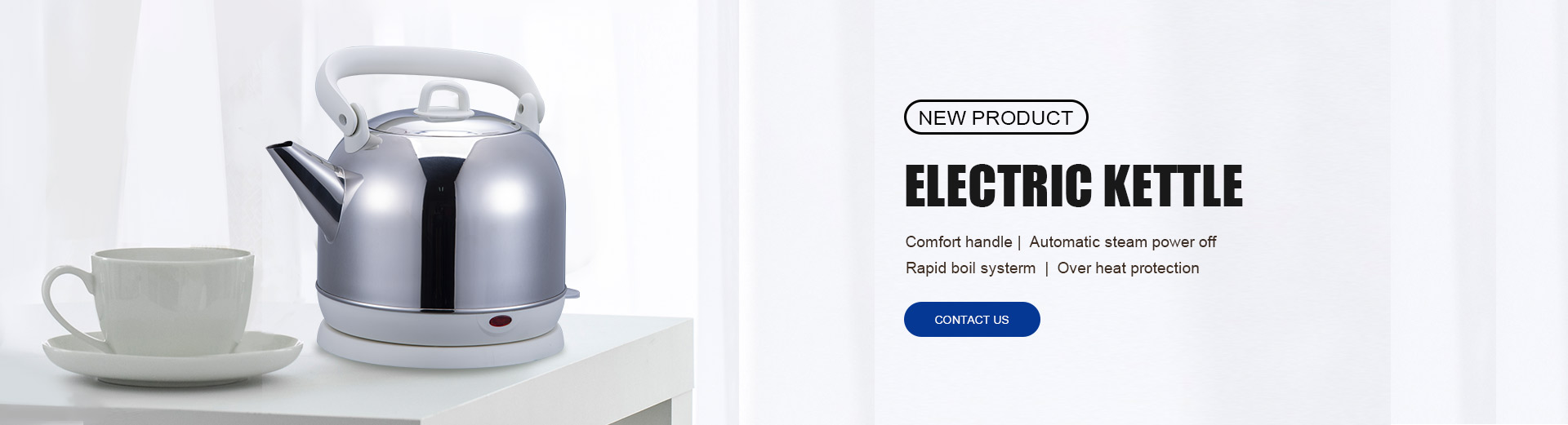
Making hard boiled eggs in an electric kettle is possible, but it should be handled as a controlled heating task rather than a standard boiling-water application. For food safety, eggs should be cooked until both the yolk and white are firm and reach 160°F. After cooking, hard-cooked eggs should be refrigerated and used within 1 week.
Place the eggs gently in the kettle, add enough water to cover them, and start heating. Once the water reaches a full boil, let the eggs remain in hot water until the yolk becomes fully set, then cool them quickly in cold water. This method sounds simple, but it places extra demands on the kettle because eggshell contact, repeated boiling, and post-cooking residue all affect long-term performance.
Not every kettle is equally suitable for this use. SHENBAO highlights food-grade stainless steel interior options, concealed heating elements, dry-boil protection, and automatic shut-off in its kettle range. These details matter because exposed coils are harder to clean, while concealed heating structures are better for hygiene and easier maintenance after contact with mineral residue or food particles.
For buyers planning private label or volume sourcing, the more important question is not only how to boil eggs, but how to keep product performance stable across repeated shipments. SHENBAO presents itself as a direct manufacturer, with integrated mold design, injection molding, metal stamping, and final assembly under ISO9001 quality management. Compared with a trading model, this structure usually gives better control over lead time, technical communication, and corrective action when product details need adjustment.
In an OEM electric kettle project, buyers should confirm capacity, inner material, heating structure, power rating, plug standard, logo method, and packaging before sample approval. In an ODM process, the review should go deeper into lid fit, heating behavior, cleaning convenience, and safety protection logic. A clear project sourcing checklist reduces risk in bulk supply and helps avoid later issues in commercial-grade programs. This is especially important when a kettle may be used for more than simple water boiling.
Electric kettle production generally includes stainless steel forming, plastic injection molding, metal stamping, thermostat installation, and final assembly. Key quality control checkpoints include heating stability, auto shut-off response, dry-boil protection, leakage testing, and connector durability. SHENBAO states that it uses advanced equipment and detection capability, which supports more consistent batch quality in export production.
Material selection is central to both safety and durability. SHENBAO states that its kettle programs support certifications such as CE, CB, GS, RoHS, LFGB, and EMC, while selected models use 304 food-grade stainless steel. For export market compliance, these points help buyers align sourcing decisions with electrical safety requirements and food-contact expectations in target regions.
| Check item | Why it matters |
|---|---|
| Food-grade inner tank | Supports safer food contact |
| Concealed heating element | Easier cleaning after use |
| Auto shut-off | Improves operating safety |
| Dry-boil protection | Reduces misuse risk |
| Certification package | Supports export compliance |
| Pilot sample review | Confirms actual use performance |
A kettle used to make hard boiled eggs should be evaluated by structure, safety logic, material standard, and factory control, not by price alone. In long-term sourcing, the better result usually comes from a manufacturer that controls the full process from design to final inspection.