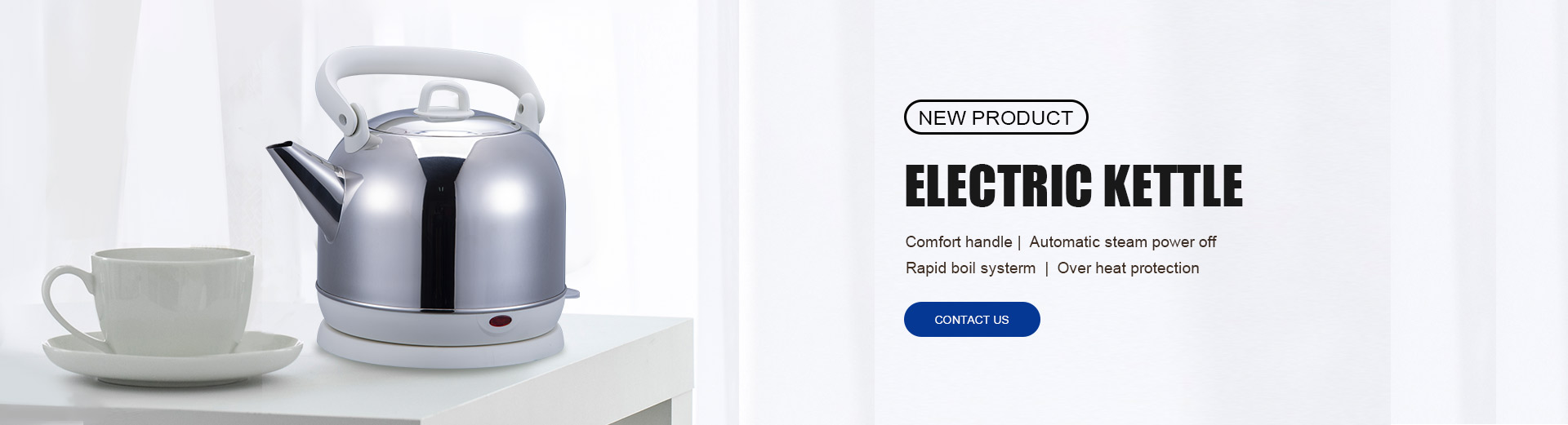
Choosing between an electric kettle and an induction kettle depends on what the product is expected to do in real use. For fast daily boiling, an electric kettle is usually the better choice because it is purpose-built for heating water, easier to operate, and commonly recognized as a faster and lower-energy way to boil water. The U.S. Department of Energy specifically notes that using an electric kettle to boil water is faster and uses less energy.
An electric kettle combines the heating system, control logic, and safety functions in one product. That makes operation simple and repeatable for home appliance lines, hotel room supply, office pantry programs, and retail distribution. An induction kettle still depends on an induction base or cooktop, so the system is less integrated and usually less convenient for quick, repeated boiling tasks. Even though induction heating can be highly efficient in theory, real user value is not only about energy transfer. It is also about speed, product simplicity, and easier standardization in mass-market applications.
An induction kettle can be attractive when buyers want multi-use cookware logic, broader kitchen compatibility, or a solution that works within an induction cooking system. Induction heating is often described as highly efficient because it heats compatible cookware directly with less heat loss than many traditional stovetop methods. Still, for a dedicated water-boiling product line, the electric kettle usually has a clearer advantage because it is purpose-driven and more suitable for fast, repeat daily use.
This comparison becomes more meaningful when buyers work directly with a manufacturer instead of a trader. SHENBAO presents itself as a professional electric kettle manufacturer integrating mold design and manufacturing, injection molding, metal stamping, and complete assembly. The company also states that it operates under ISO9001 and supports certifications such as CE, CB, GS, RoHS, and LFGB, which helps buyers evaluate long-term supply stability rather than unit price alone.
In an OEM electric kettle or ODM kettle project, the decision between electric and induction should be made early based on product positioning, target market, voltage, plug type, heating logic, user scenario, and compliance requirements. A practical project sourcing checklist should include sample approval, heating speed validation, shut-off testing, dry-boil protection review, packaging confirmation, and pre-shipment inspection. For bulk supply considerations, the electric kettle is often easier to standardize because the heating system and safety functions are already integrated into one appliance.
Electric kettle production typically includes stainless steel forming, plastic injection molding, metal stamping, thermostat installation, and final assembly. Quality control checkpoints should cover heating stability, automatic shut-off, dry-boil protection, leakage testing, connector durability, and final appearance inspection. These details matter because the better product is not only the one that boils water, but the one that stays consistent across repeated production runs. SHENBAO highlights calibrated heating systems, concealed heating structures, and structured safety validation in its factory content, which supports more dependable export supply.
For export market compliance, electric kettles fall under IEC 60335-2-15, the safety standard for appliances used for heating liquids. That matters in sourcing because product safety, heating performance, and compliance readiness all influence whether a project moves smoothly from development to shipment. SHENBAO also states support for CE, CB, GS, RoHS, and LFGB, which is important for buyers targeting multiple overseas markets.
| Item | Electric kettle | Induction kettle |
|---|---|---|
| Main use | Dedicated water boiling | Depends on induction heating system |
| Daily convenience | Higher | Lower |
| System simplicity | Integrated appliance | Two-part use logic |
| OEM standardization | Easier | More variable |
| Best fit | Fast-boiling programs | Induction-based kitchen systems |
For most sourcing projects, an electric kettle is the better option because it offers faster boiling, simpler operation, easier OEM and ODM development, and stronger suitability for bulk supply. An induction kettle still has value in specific kitchen-system scenarios, but for a focused hot-water appliance program, the electric kettle usually delivers the more practical balance of efficiency, convenience, quality control, and export readiness. SHENBAO’s integrated manufacturing model makes that route more reliable for long-term supply planning.