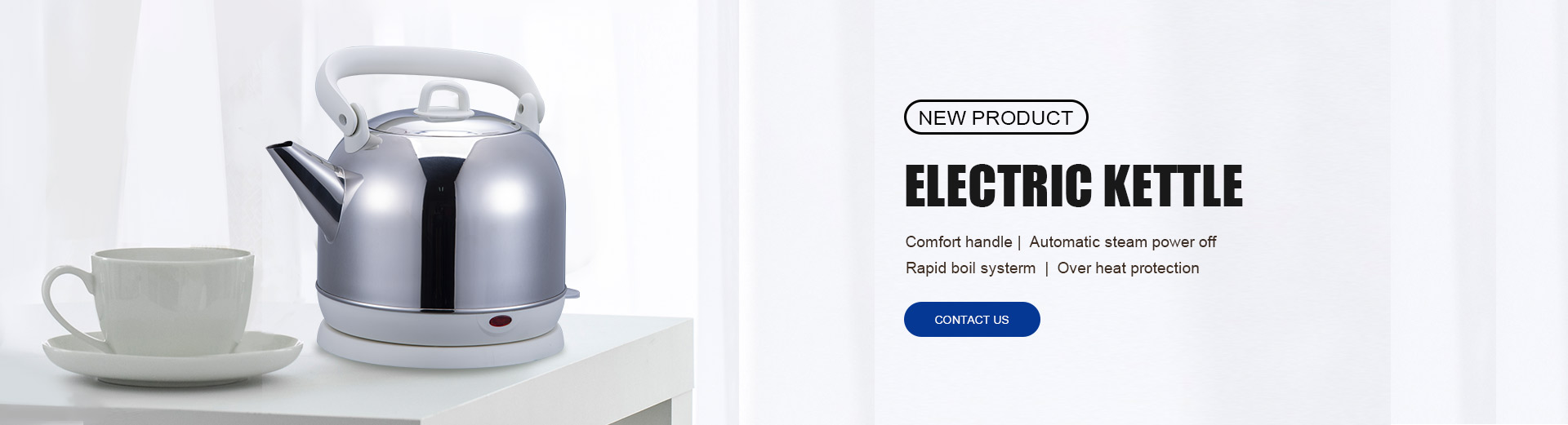
Handle design directly affects electric kettle safety, durability, and user experience by influencing grip stability, heat insulation, load balance, and pouring control.
The handle is one of the most important structural components of an electric kettle because it connects the user with the heated appliance during daily operation. A well-designed handle does more than provide a place to hold the kettle; it reduces operating risks and improves long-term product reliability.
During manufacturing, handle structure needs to be evaluated together with kettle capacity, body material, heating power, and usage environment. For example, a large-capacity Stainless Steel Kettle requires a stronger handle structure because the total weight increases significantly when filled with water.
A professional electric kettle manufacturer typically considers mechanical strength, ergonomic comfort, heat resistance, and assembly stability during the handle development process. These factors directly influence whether the kettle remains safe after thousands of lifting and pouring cycles.
The shape of an electric kettle handle determines how securely users can control the appliance during pouring. Poor handle geometry may cause unstable gripping, especially when the kettle contains hot water.
A suitable handle design usually includes:
Ergonomic grip angle: The handle angle should allow natural wrist movement and reduce pressure during pouring.
Balanced weight distribution: The connection position between the handle and kettle body affects overall balance and prevents sudden tilting.
Comfortable grip size: The handle opening should provide enough space for different hand sizes while maintaining control.
Anti-slip surface design: Textured or carefully finished surfaces help improve stability during operation.
For household kitchens, hotels, offices, and commercial applications, handle ergonomics become especially important because repeated use increases the impact of small design issues.
Handle material selection directly affects heat insulation and structural durability. Since electric kettles operate with high-temperature water, the handle must maintain a comfortable temperature while supporting the kettle body.
Common handle materials include heat-resistant plastics, reinforced polymers, and composite structures. These materials are selected according to factors such as:
Temperature resistance
Mechanical strength
Aging performance
Chemical stability
Surface durability
High-quality electric kettles often use heat-resistant materials combined with reinforced connection points. This design reduces the risk of deformation or loosening after long-term use.
In OEM and ODM electric kettle production, handle material testing is an important part of product development because different markets may have different safety requirements and usage conditions.
Yes. The connection between the handle and kettle body plays a key role in product lifespan. A handle may appear simple externally, but its internal fixing structure determines whether it can withstand repeated loading.
A reliable handle structure should consider:
| Design Factor | Impact on Quality |
|---|---|
| Strong fixing points | Prevents handle loosening during repeated use |
| Reinforced connection area | Improves resistance against weight stress |
| Stable assembly process | Ensures consistent product performance |
| Quality inspection | Reduces potential safety issues before shipment |
Manufacturing experience shows that handle failures are often related to connection strength rather than the handle material itself. Therefore, professional production processes focus on both component selection and assembly precision.
Pouring performance is closely related to handle position and weight balance. When a kettle is filled with water, the center of gravity changes, making handle design critical for smooth operation.
A well-balanced handle helps users:
Control water flow more accurately
Reduce wrist fatigue
Avoid sudden movement during pouring
Improve overall kitchen safety
For electric kettles with larger capacities, such as 1.7L or above models, handle structure becomes even more important because the filled weight creates greater pressure on the handle and connection area.
When selecting an electric kettle, buyers should evaluate handle design together with heating performance and overall construction quality.
Important considerations include:
The handle should remain comfortable to hold after boiling. Good insulation reduces the risk of accidental burns.
The handle should maintain stability when the kettle is fully filled and lifted repeatedly.
The grip position, angle, and size should support natural hand movement and comfortable pouring.
For bulk production, consistent handle assembly quality is essential to maintain product reliability across large quantities.
Modern electric kettle manufacturing combines product engineering, material testing, and production quality control to optimize handle performance.
A professional electric kettle factory evaluates handle designs through multiple stages:
Prototype testing for structure and appearance
Load testing for mechanical strength
Heat resistance testing for user safety
Assembly inspection for production consistency
With OEM and ODM development capabilities, manufacturers can customize handle structures based on market requirements, including different capacities, body materials, and product styles.
Handle design influences more than appearance. It affects safety, usability, durability, and customer satisfaction throughout the product lifecycle.
For electric kettle manufacturers, a successful handle design requires a balance between ergonomic experience and engineering reliability. By combining suitable materials, strong structural design, and strict quality control, electric kettles can achieve safer operation and longer service life in global markets.